

SC-300 Exam questions explained · Exam Q&A 2
5 SC-300 Authentication Questions Explained
Five SC-300 exam-style questions on authentication and Conditional Access, with answers, reasoning and a 4-step method for any scenario.
Authentication and access management is the largest SC-300 domain, 25–30% of the exam. The questions are scenarios: a short story, four plausible answers, and one that fits best. Knowing the features is not enough; you need a way to read the scenario.
Here is the method we use in the course, then five questions from the exam Q&A video, each with the reasoning.
A four-step method for any scenario
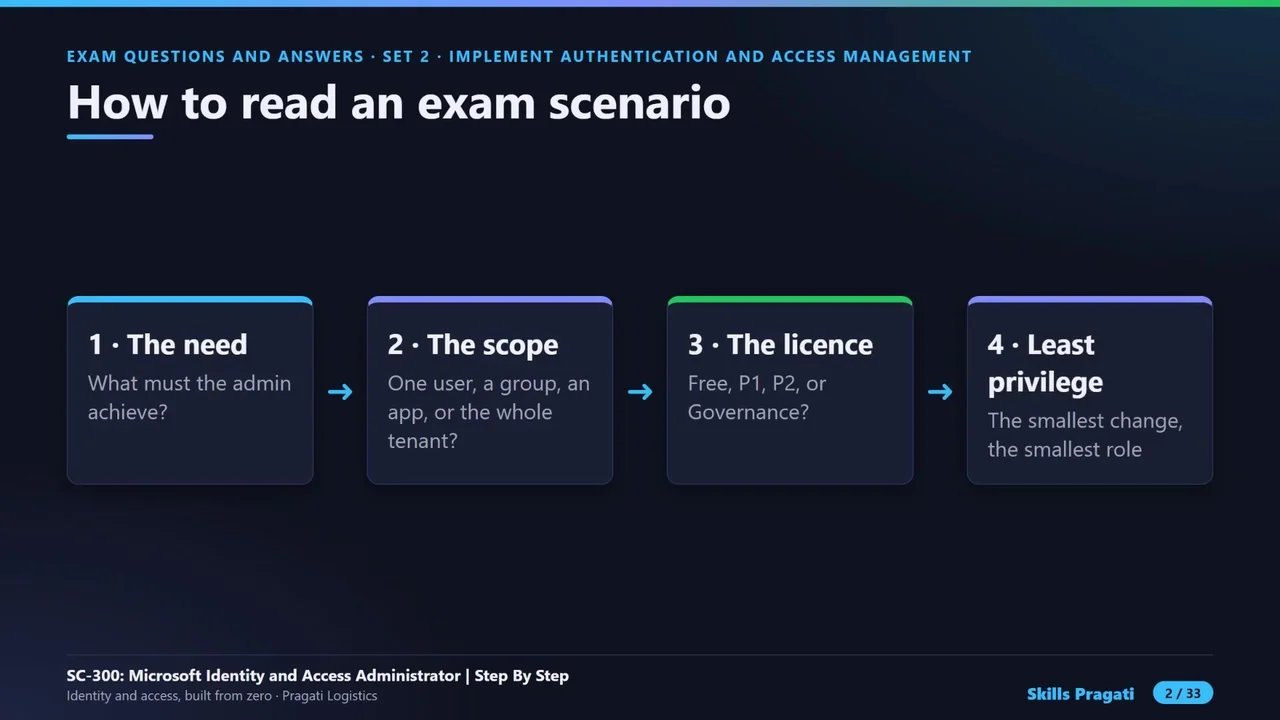
- The need: what must the admin achieve?
- The scope: one user, a group, one app, or the whole tenant?
- The licence: many wrong answers need P2 or ID Governance when the scenario has P1.
- Least privilege: of what remains, choose the smallest change and the smallest role that meet the need.
Question 1: day one with no phone
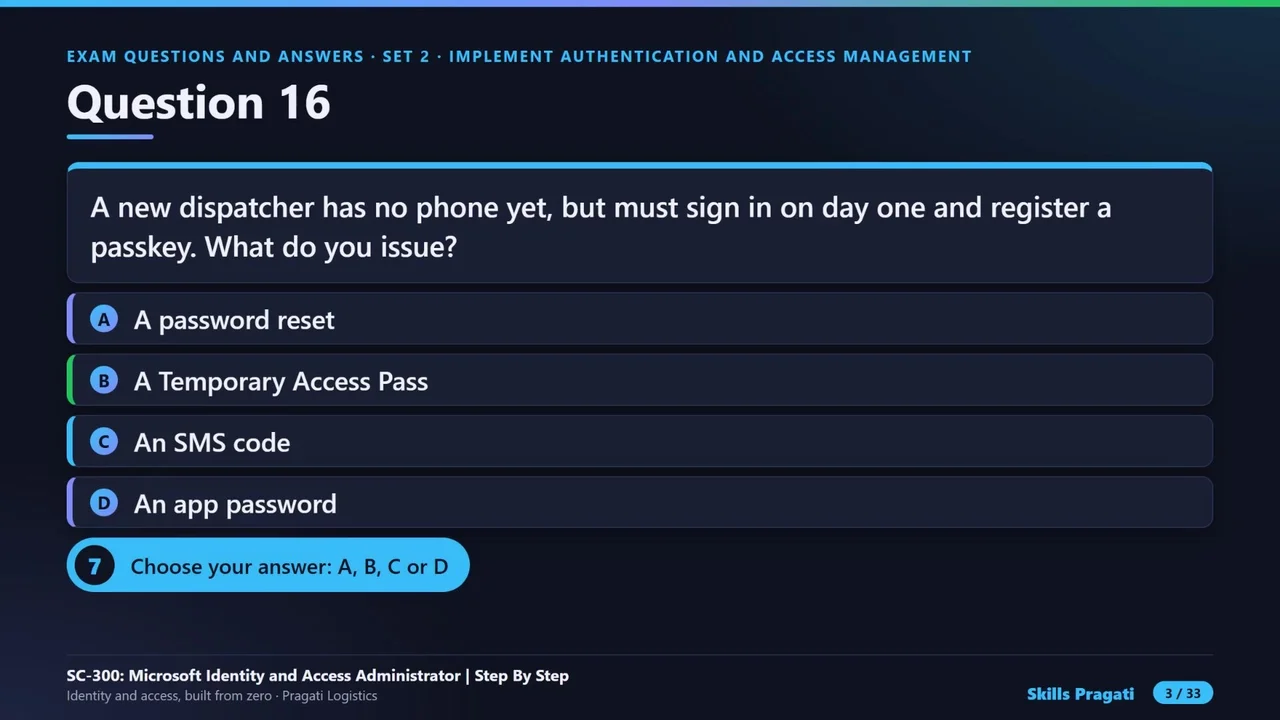
A new dispatcher has no phone yet, but must sign in on day one and register a passkey. What do you issue? A password reset, a Temporary Access Pass, an SMS code, or an app password?
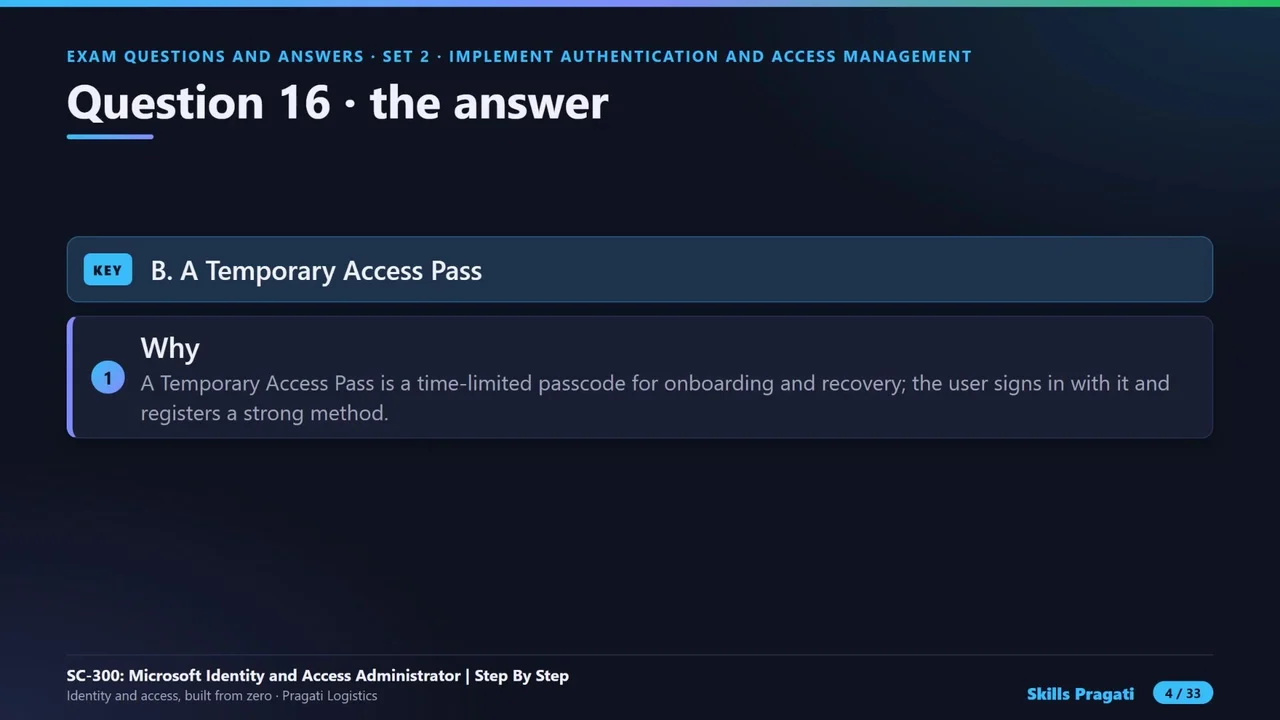
Answer: a Temporary Access Pass. It is a time-limited passcode for onboarding and recovery; the user signs in with it and registers a strong method.
Question 2: phishing-resistant admins
Which method is phishing-resistant for admins? SMS, Authenticator push without number matching, passkeys (FIDO2), or a voice call?
Answer: passkeys (FIDO2). Passkeys, Windows Hello for Business and certificate-based authentication are phishing-resistant. SMS and voice are not.
Question 3: security defaults are on
Security defaults are on. You want MFA only for the Dispatch group, and to block legacy authentication. What must happen first?
Answer: turn security defaults off, then create Conditional Access policies. The two cannot both be on. With P1, turn defaults off and replace them with policies, starting in report-only. “Add Conditional Access alongside” is the tempting wrong answer.
Question 4: who would a new policy affect?
Before turning a new policy on, you want to see who it would affect, using real sign-ins. Which mode? On, Off, report-only, or What If?
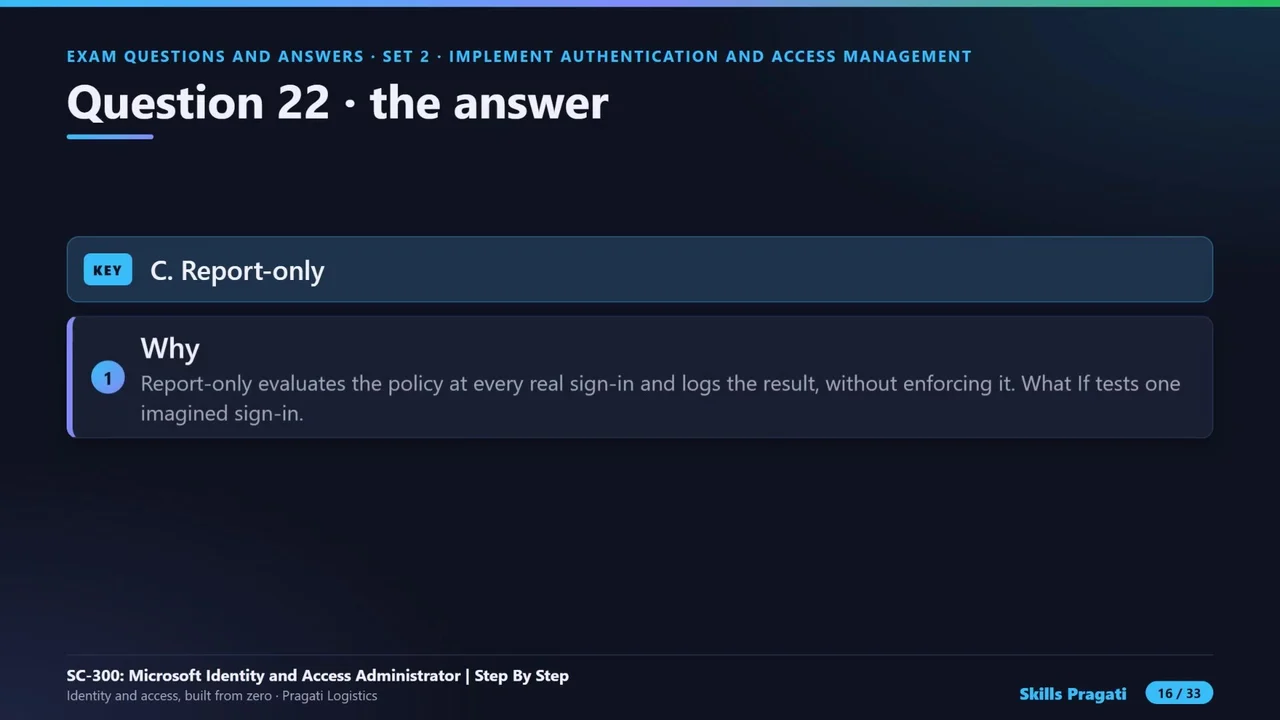
Answer: report-only. It evaluates the policy at every real sign-in and logs the result without enforcing it. What If tests one imagined sign-in.
Question 5: emergency access accounts
Why must you exclude two emergency access accounts from every Conditional Access policy?
Answer: so a broken policy or an MFA outage cannot lock every admin out. Break-glass accounts are the way back in. Exclude them, and alert whenever they are used.
How to use these
The video has fifteen questions for this domain, with every answer explained and the Part to rewatch. Do them after Parts 5 to 8, note the ones you miss, and rewatch only those Parts. Then take the timed mock exam on the course page.
Do it yourself
- The full SC-300 courseEvery Part, free on YouTube, in order
- Hands-on lab guideThe exact steps, what it costs, how to clean up
- Practice simulationRehearse every click in your browser; the first lab is free
- Mock examFree 10-question sample, then the full timed mock scored by domain
Lab guides, practice and full mock exams come with a subscription. See the plans